
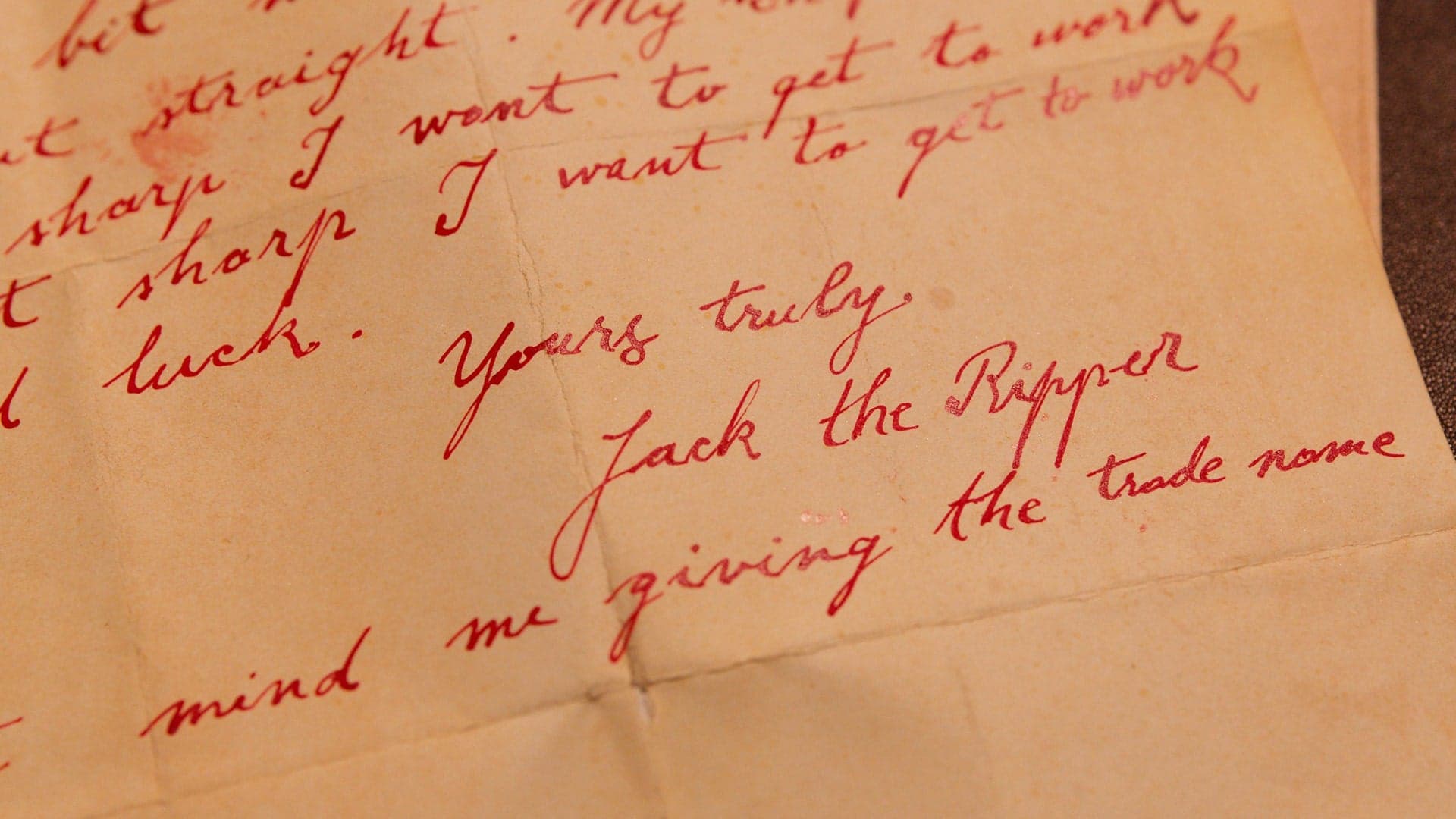
Everyone knows the name Jack the Ripper. It’s one of the most recognisable monikers in the history of crime, a name that has inspired films, books, walking tours, and endless theories for nearly 140 years. But here’s something that surprises most people when they first hear it: the name may have been created by a journalist rather than the killer.
Primary-source note: The National Archives catalogues the original “Dear Boss” letter as MEPO 3/3153: dated 25 September 1888 and addressed to the Central News agency. Its authorship has never been established.
This is the story of a single letter, dated 25 September 1888, that changed everything — and may have been a hoax all along.
Before the Name: “The Whitechapel Murderer”
In the summer and early autumn of 1888, a killer was stalking the streets of Whitechapel in London’s East End. By the end of September, four of the five canonical victims had been murdered: Mary Ann Nichols, Annie Chapman, and then Elizabeth Stride and Catherine Eddowes in the ‘Double Event’ on 30 September. The ‘Dear Boss’ letter was dated five days earlier, before the double murder, and was later forwarded to the police.
The press were covering the murders obsessively, but they had no name for the killer. Newspapers referred to him as “the Whitechapel Murderer” or more sensationally “Leather Apron”, a nickname that had emerged from early witness descriptions of a man seen intimidating women in the area. It was dramatic enough, but nothing like what was coming.
The Letter That Changed Everything
On 27 September 1888, a letter arrived at the offices of the Central News Agency in London. It was written in red ink, in a confident, somewhat mocking hand, and it was addressed simply: “Dear Boss.”
The letter read, in part:
“I keep on hearing the police have caught me but they wont fix me just yet. I have laughed when they look so clever and talk about being on the right track. That joke about Leather Apron gave me real fits. I am down on whores and I shant quit ripping them till I do get buckled.”
And then, near the end, the writer signed off:
“Yours truly, Jack the Ripper”
It was the first time that name had ever appeared in writing. The Central News Agency forwarded the letter to Scotland Yard on 29 September. The ‘Double Event’ murders followed during the night of 30 September, and on 1 October a follow-up postcard arrived, also signed ‘Jack the Ripper’ and referring to the two killings. This second piece of correspondence became known as the “Saucy Jacky” postcard.
Scotland Yard made a decision that would cement the name forever: they released facsimiles, printed copies, of both communications to the press on 3 October 1888, hoping that someone would recognise the handwriting. Instead, they handed the Victorian media the story of the century. Within days, the name Jack the Ripper was on the front page of every newspaper in Britain.
A Media Sensation, and a Flood of Copycats
The public reaction was immediate and extraordinary. The name caught something that “Leather Apron” never had: it was vivid, theatrical and instantly memorable. Within weeks, Scotland Yard was receiving hundreds of letters, all claiming to be from “Jack the Ripper,” most of them copying phrases and style from the original Dear Boss letter.
The vast majority were obvious hoaxes, and the police knew it. The effect was already irreversible. The name had taken on a life of its own.
Was It a Hoax All Along?
Here’s where the story takes a genuinely fascinating turn. In the years following the murders, senior police officials began expressing serious doubts about the letter’s authenticity. Chief Inspector John Littlechild and other investigators came to believe that the Dear Boss letter and the Saucy Jacky postcard were not written by the killer at all, but by a journalist, looking to keep the story alive.
In 1931, those suspicions crystallised into something more specific. Journalist Fred Best was later reported to have claimed that he and another newspaperman created Ripper communications to sustain public interest. The account is disputed and should be treated as a reported confession, not proof of authorship.
Think about what that means for a moment. The most famous alias in criminal history may have been invented in a newsroom, not by a killer.
Modern linguistic research has suggested that the ‘Dear Boss’ letter and ‘Saucy Jacky’ postcard probably shared an author, but it does not identify that person or prove a journalistic hoax. In 2018, Andrea Nini, a forensic linguist at the University of Manchester, published research on the authorship of the Ripper letters concluding that the Dear Boss letter and the Saucy Jacky postcard were probably written by the same person — suggesting a common author behind both, rather than an impulsive killer dashing off correspondence between murders. If the letters share an author, and that author wasn’t the Ripper, then the “Jack the Ripper” name is one of the most consequential examples of media myth-making in criminal history.
Why Does It Matter?
It matters for several reasons, and not just as a historical curiosity.
First, it’s a reminder of how powerfully a name can shape a story. Before the Dear Boss letter, the Whitechapel murders were a horrifying local crime story. After it, they became a global sensation, with a named, almost mythologised villain at the centre. The name gave the public something to latch onto, something almost fictional in its drama. It made “Jack the Ripper” feel like a character rather than a crime.
Second, it raises a genuine ethical question that still feels relevant today: to what extent did the press of 1888 amplify — or even partly create — the terror that gripped London? The Victorian popular press was fiercely competitive, often sensationalist and governed by far fewer formal controls than modern newsrooms. If Fred Best’s confession is accurate, then journalists didn’t just cover the story. They wrote themselves into it.
Third, and perhaps most intriguingly: if the letters were a hoax, then we’ve been calling this killer by the wrong name for nearly 140 years. The Whitechapel Murderer is still unidentified. But “Jack the Ripper” — a name that may have been created for publicity — has outlasted every suspect, theory and investigation.
Where Is the Letter Now?
The original ‘Dear Boss’ letter is held by The National Archives within the Metropolitan Police records, catalogued as MEPO 3/3153. A facsimile is reproduced in numerous books and online archives, and it remains one of the most studied documents in criminal history.
If you’re visiting London, the letter’s story is a central part of most serious Jack the Ripper walking tours in London — and understanding it changes how you see the whole case. Because before you can ask “who was Jack the Ripper?”, it’s worth asking a more unsettling question first: who decided to call him that?
The answer may have been a journalist seeking publicity — but the author has never been established. What is certain is that the name outlived the investigation that produced it.
The name stuck. The man never did. Dive into the five most famous suspects behind the name.