
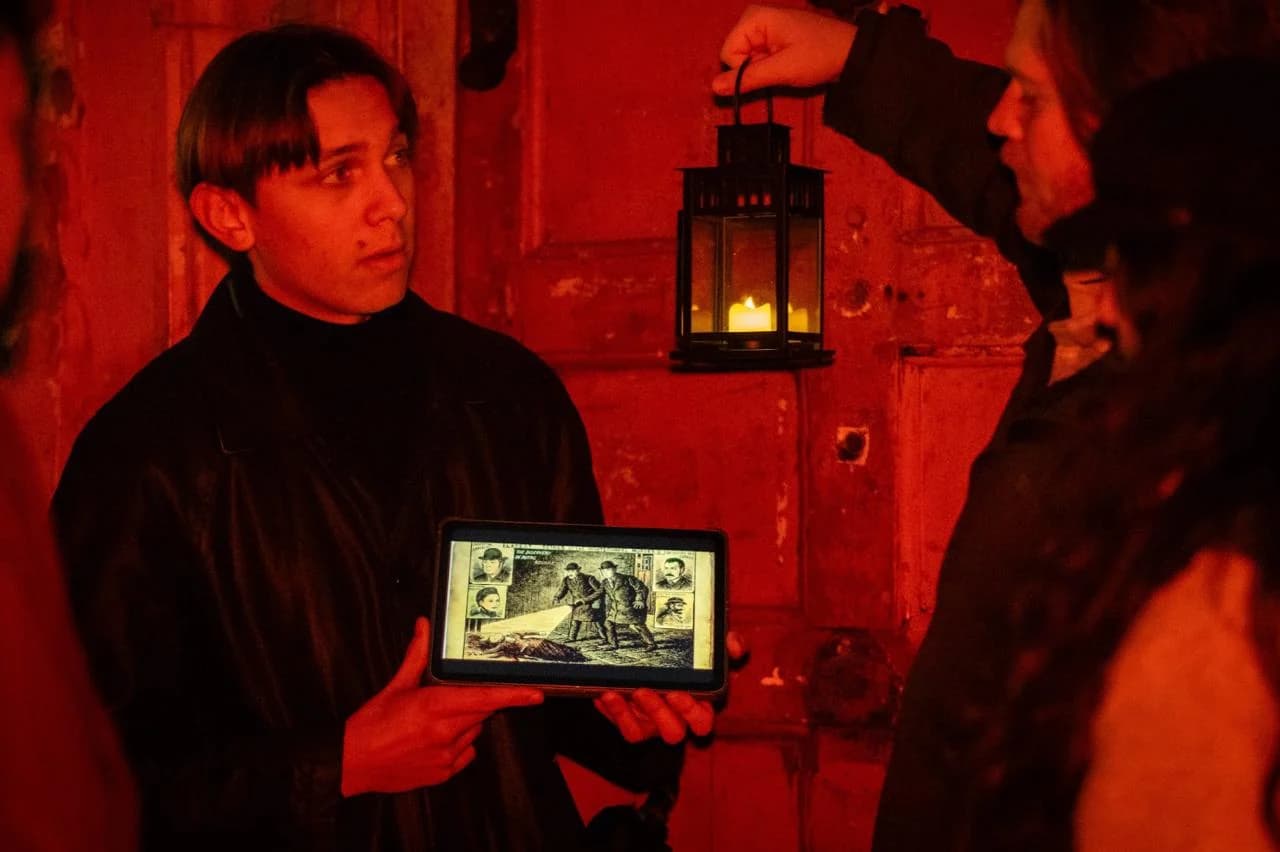
A Jack the Ripper school trip can do far more than revisit an unsolved murder case. Planned responsibly, a walk through Whitechapel lets students examine Victorian poverty, migration, housing, policing, journalism and the limits of historical evidence in the district where those issues can be studied together.
This guide is for teachers considering a Whitechapel history trip, particularly for Key Stage 3, GCSE and A-Level groups. It explains the curriculum links, what to ask a tour provider, how to prepare students and how to keep the focus on evidence and the people who lived in the East End—not on sensationalism.
Last reviewed: 5 October 2026. Teachers should check the current exam specification and request the provider’s current route, risk assessment and content policy before booking.
Why Visit Whitechapel Rather Than Study It Only in the Classroom?
Whitechapel is unusually well suited to place-based learning. Students can move between streets associated with lodging houses, markets, immigrant communities, police jurisdictions and the 1888 investigation within a relatively compact area. Much of the relevant built environment has disappeared or been redeveloped, so surviving street relationships are most useful when read alongside historic maps, plans, photographs and records.
A walking tour also makes historical distance visible. Students must compare what survives with what has disappeared, ask whether a modern location can represent an 1888 environment, and distinguish a documented address from an approximate historic position. Those are not merely tour-guide questions; they are questions about how historians reconstruct the past.
The strongest learning objective: use the murders as a case study, not the whole story. The educational value lies in what the investigation reveals about Victorian Whitechapel, policing, inequality, the press and historical evidence.
How Does a Whitechapel Visit Link to the Curriculum?
Pearson Edexcel GCSE History
The clearest curriculum match is Pearson Edexcel’s historic environment study, Whitechapel, c1870–c1900: crime, policing and the inner city. Pearson’s teaching material identifies housing, overcrowding, poverty, migration, lodging houses, H Division, investigative policing, competing police jurisdictions and media coverage of the murders as central areas of study.[1]
A well-structured visit can therefore turn specification language into place-based enquiry. Students can consider why policing alleys and courts was difficult, how jurisdiction affected the investigation, and why newspaper reporting created additional pressure. The visit is supplementary: it cannot cover the full specification or replace classroom teaching and source work.
Key Stage 3 and A-Level
For Key Stage 3, Whitechapel supports broader work on Victorian cities, industrialisation, migration, poverty, public health and social reform. For older students, the same streets can support deeper source evaluation: who created a document, why it was preserved, what it leaves out and how later storytelling changes public memory.
The National Archives offers a Whitechapel education session for Key Stages 3 and 4 that explores poverty, immigration, women’s lives, housing and the usefulness of historical sources.[2] That makes an archive-to-street sequence especially useful: analyse a source before the trip, test it against the location, then revisit it afterwards.
What Can Students Learn on a Jack the Ripper School Tour?
Victorian social conditions
Overcrowding, insecure housing, casual employment and the role of common lodging houses—without reducing every East End resident to a stereotype.
Policing before modern forensics
The work of Metropolitan Police H Division, the separate City of London Police, limited investigative techniques and the difficulties created when the investigation crossed jurisdictions.
Migration and community
Whitechapel as a diverse neighbourhood shaped by Irish and Eastern European migration, Jewish communities, work, religion and political tension—including unsupported antisemitic scapegoating during the investigation.
Newspapers and public fear
How dramatic reporting, anonymous letters and commercial competition helped turn an unsolved investigation into an enduring legend.
Source reliability
The difference between contemporary evidence, later recollection, press invention and modern speculation.
The victims as people
The lives, housing, relationships and work of Mary Ann “Polly” Nichols, Annie Chapman, Elizabeth Stride, Catherine Eddowes and Mary Jane Kelly—not only the circumstances of their deaths. “Canonical five” is later historical shorthand, not a formal contemporary police category, and the number attributable to one offender remains uncertain.
Charles Booth’s poverty maps are particularly useful for comparing place and evidence, but they are not a direct snapshot of the murders in 1888. The interactive LSE map principally presents the 1898–99 survey, created roughly a decade later, and colour-codes streets by the income and social class assigned to their residents. Students should consider both the time gap and the assumptions built into the surveyors’ classifications.[3]
The case also offers an opportunity to challenge inherited myths. London Museum notes that historians have increasingly focused on the women’s lives and that contemporary and later accounts often labelled all five as prostitutes without adequate evidence.[4] For students, this is a practical lesson in how repetition can harden an assumption into “fact”.
Is Jack the Ripper an Age-Appropriate School Topic?
It can be, provided the delivery is restrained and matched to the group. The educational case does not require graphic detail. Teachers should agree boundaries around spoken descriptions, images, violence and sensational speculation with the provider before booking.
Our school tour is designed mainly for Year 8 to Year 11 groups and can be adapted for A-Level students. Teachers should still share the age range, learning objectives, desired content boundaries and any pastoral considerations in advance. A class studying source reliability needs a different emphasis from a group visiting as part of a general London programme.
A responsible guide should explain uncertainty openly. “Canonical five” is later historical shorthand, disputed suspects should be identified as theories, and modern streets should not be presented as untouched crime scenes. Students should leave with better questions, not an invented solution to an unsolved case.
Teacher Planning Checklist
- Define one or two learning objectives. Decide whether the priority is policing, the historic environment, source evaluation, Victorian poverty or media history.
- Confirm the level of detail. Tell the provider the students’ ages and agree how violence, spoken descriptions and images will be handled.
- Request the practical documents. Ask for a current risk assessment, route outline, emergency contact, cancellation terms and accessibility information.
- Agree staffing and group arrangements. Confirm the maximum group size, free staff places, guide allocation and how guides communicate with teachers. Apply your school or local-authority requirements for staff-to-student ratios.
- Check the route. Whitechapel includes busy roads, cobbles and narrow passages that may create barriers. Discuss mobility, sensory, SEND and medical needs, possible route adaptations and any inaccessible sections before confirming.
- Plan movement and emergencies. Agree road-crossing procedures, headcounts, toilets, an emergency regroup point and what happens if transport disruption delays the group.
- Plan for London weather. Comfortable shoes and waterproof layers matter more than atmospheric costumes. The tour is an outdoor lesson.
- Prepare students for public space. The group will move through working streets used by residents, businesses and other visitors.
- Plan a follow-up task. A visit is most valuable when students must use what they observed afterwards.
Our Jack the Ripper school tour in London runs for approximately 90 minutes. Group sizes and departure times are flexible, with risk assessments, free staff places and group rates available on request. The emphasis can be adapted around your class’s age and learning objectives; teachers should agree the exact route, content boundaries and any possible accessibility adaptations before booking.
Activities Before, During and After the Visit
Before the trip
- Locate Whitechapel, Spitalfields and the City of London on a modern map.
- Compare the modern map with the Charles Booth poverty map, while noting that the interactive survey principally dates from 1898–99 rather than 1888.
- Give students one newspaper extract, police document or map and ask what it can—and cannot—prove.
- Introduce the five women through short biographies rather than beginning with suspect theories. Our guide to the canonical five victims provides a responsible starting point.
During the trip
- What features of this street would have made policing difficult in 1888?
- Which parts of the guide’s account come from contemporary evidence, and which are inference?
- How has redevelopment changed what historians can observe here?
- Who produced the sources being discussed, and whose voice is missing?
- Why did the press find the case so commercially powerful?
After the trip
- Create an annotated map connecting locations with specific curriculum themes.
- Write a judgement on the greatest obstacle facing police in Whitechapel.
- Compare a sensational newspaper account with a police or inquest source.
- Audit a modern Jack the Ripper claim: what is its evidence, and how certain should the wording be?
- Write a short museum label about one victim that restores identity without using graphic crime detail.
Questions to Ask Any School Tour Provider
- How do you adapt the tour for different ages and exam specifications?
- Do you centre the historical environment and the victims, or primarily tell suspect stories?
- What graphic content, if any, is included?
- Can you provide a current risk assessment and route plan?
- How do you manage large groups on narrow pavements?
- What adjustments are possible for mobility, hearing, sensory or medical needs?
- Are staff places included, and what is the cancellation policy?
- What happens in severe weather or major transport disruption?
Planning a Whitechapel school trip?
See the full school-group tour details or contact the team with your preferred date, group size, year group and learning objectives. We can then recommend the most appropriate format and provide a quote.
Jack the Ripper School Trips: Frequently Asked Questions
Is the tour suitable for GCSE History?
It can support Pearson Edexcel’s Whitechapel historic-environment study when the route and teaching emphasis are matched to your scheme of work. It is a supplementary learning experience, not coverage of the complete specification or a replacement for classroom teaching. It can also support broader work on Victorian Britain, policing, migration, poverty, journalism and source evaluation.
What age is the school tour designed for?
It is primarily designed for Year 8 to Year 11 students and can be adapted for A-Level groups. Teachers should discuss younger groups and any specific sensitivities before booking.
How long is the school tour?
The standard school tour lasts approximately 90 minutes. Exact timing and route arrangements should be confirmed for your group.
Is the content graphic?
Teachers should agree this explicitly before booking. Ask what spoken descriptions and images are used, and specify the boundaries appropriate for your students. The tour can be framed around the historical environment, policing, evidence, the press and the women’s lives rather than graphic detail.
Can large school groups be accommodated?
Group sizes are flexible. Share your student and staff numbers when requesting a quote, and ask how many guides would be assigned, how the group would be managed on narrow pavements and whether any division into smaller groups is recommended.
Is the Whitechapel route accessible?
The area includes cobbles, narrow passages and busy pavements that may create barriers for some visitors. Contact the team before booking to discuss individual needs, possible route adaptations and any sections that cannot be made accessible; contacting the operator does not guarantee that every part of the route will be suitable.